
EV & NEV insurance · Market perspective
Lessons from China’s EV insurance market
A case study for Southeast Asian insurers
Mandy Phan
Managing Partner · 9 July 2026 · 12-minute read
16.49m
NEVs sold in China, 2025
CNY 5.6bn
2025 underwriting loss
140+
Models above 100% loss ratio
3 years
Consecutive market losses
The issue was never that insurers underestimated electric vehicles. It was that they tried to insure a different technology using assumptions developed for internal combustion engine vehicles.
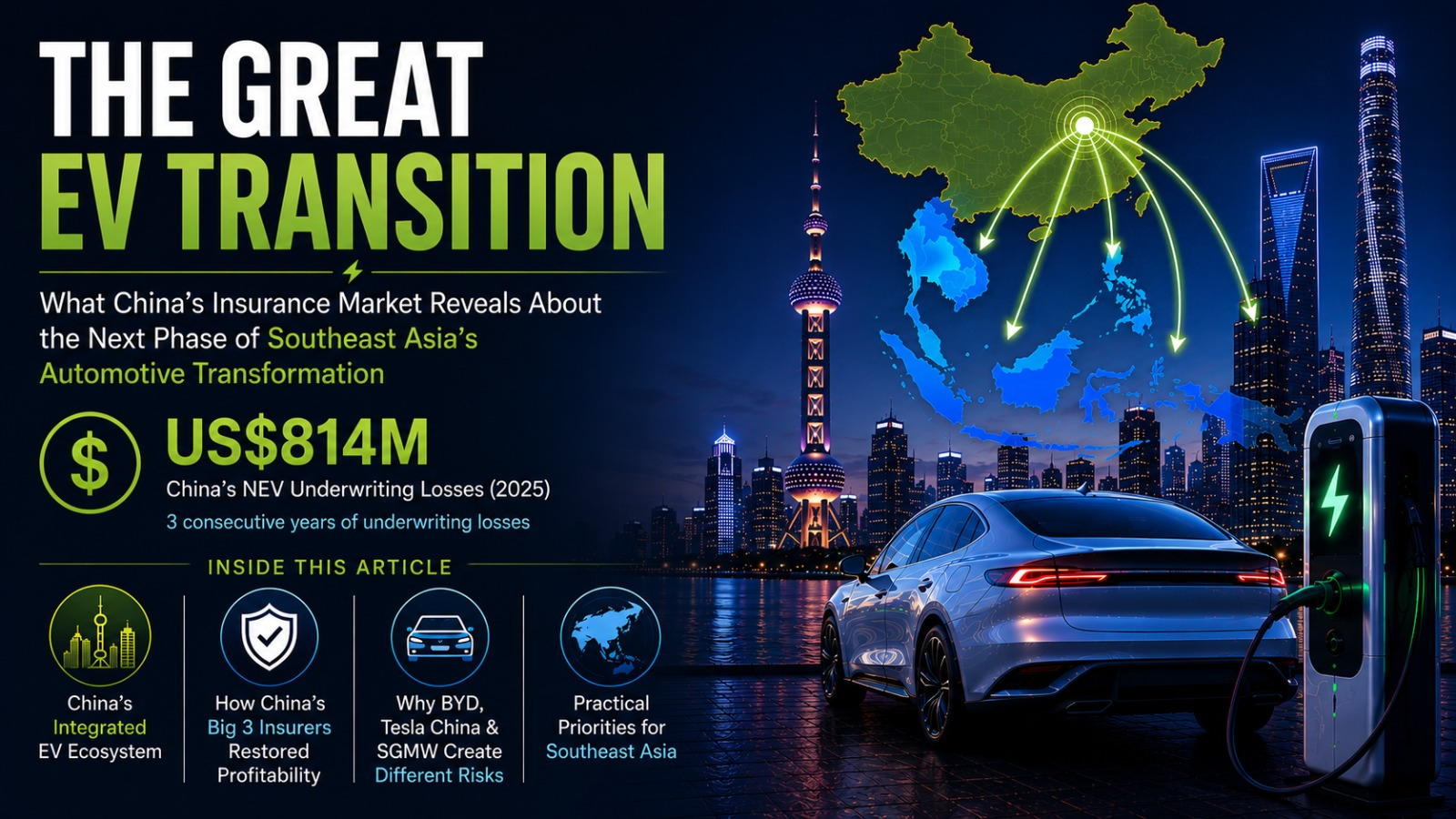
In 2025, China sold 16.49 million new-energy vehicles | more than the combined new-vehicle markets of Thailand, Indonesia and Vietnam. The same year, according to data released jointly by the China Association of Actuaries and Insurance Information Technology Management, the NEV insurance market recorded an underwriting loss of CNY 5.6 billion, approximately US$814 million.
More than 140 individual models generated loss ratios above 100%, representing over 30% of all insured NEV models. Despite premiums averaging around 80% higher than for conventional vehicles, China’s NEV market recorded underwriting losses for three consecutive years. While the market remained loss-making overall, losses narrowed and combined ratios improved.
Not every insurer lost money | and understanding why some succeeded is the most useful lesson Southeast Asia can take from China’s experience.
EV sales across the region more than doubled in 2025 to exceed half a million vehicles, with Chinese brands accounting for more than half of all sales. The same manufacturers, battery technologies and operating models that reshaped China’s insurance market are now expanding into Southeast Asia, but into markets with less mature repair ecosystems, fewer specialist technicians and more limited data.
China built an ecosystem, not only an EV market
China’s advantage was never just government subsidies. It came from building an integrated ecosystem in which vehicle manufacturing, battery production, charging infrastructure, software, financing and regulation evolved together. By 2025, China had installed more than 14 million charging points and established the world’s largest battery manufacturing base.
Chinese OEMs now collect information on battery health, charging behaviour, software performance and vehicle usage throughout the ownership cycle. Many manufacturers understand how their vehicles perform in the real world long before insurers accumulate enough claims experience to price them with confidence.
EVs are also becoming increasingly diverse. Plug-in hybrids and range-extended EVs accounted for around 40% of China’s NEV sales in 2024, up more than 10 percentage points in a single year. These vehicles combine internal combustion and electric drivetrains, resulting in repair characteristics and claims behaviour that differ from pure battery electric vehicles.
Battery chemistry also matters. Most Chinese EVs entering Southeast Asia use lithium iron phosphate batteries, which generally have lower thermal runaway risk and longer cycle life than the nickel manganese cobalt batteries commonly used in many Korean and European models. Treating all EVs as a single risk class, or applying a flat battery loading, will increasingly misprice both frequency and severity.
The result is not just manufacturing scale. It is a data advantage that is starting to reshape underwriting.
Three business models, three different insurance risks
One of the biggest lessons from China is that there is no such thing as a generic Chinese EV. Manufacturers have adopted different technologies, operating models and commercial strategies, each creating different insurance risks. Insurers are not underwriting a single EV portfolio. They are underwriting very different business ecosystems.
BYD | vertical integration
BYD shows how owning the ecosystem can become an insurance advantage. Its insurance subsidiary reported its first profit in 2025, with revenue doubling to CNY 2.87 billion and results improving from a CNY 169 million loss to a CNY 93.6 million profit. The explanation goes beyond data-driven underwriting.
BYD manufactures the battery, motor and key components, repairs vehicles through its own network and insures them. When claims are paid, much of the expenditure flows back into BYD’s own operations. Traditional insurers have little influence over parts pricing or labour costs. That is a supply-chain advantage rather than an actuarial one. It also makes external benchmarking more difficult because repair costs and margins remain within BYD’s ecosystem.
Distribution creates a second advantage. Insurance is embedded at the point of sale, avoiding broker commissions and much of the 15–25% acquisition cost borne by traditional insurers. The third advantage is information: BYD knows every vehicle it builds, from battery chemistry and software versions to component performance and repair history.
One caution remains. Motor claims typically take 12 to 18 months to develop, so one profitable year, its first, does not yet prove the model over the long term. BYD’s advantage comes from owning the ecosystem around the vehicle. As it expands into Thailand, Brazil and Hungary, that ecosystem expands with it.
SAIC-GM-Wuling | the affordability trap
SAIC-GM-Wuling took a different approach: affordable, practical EVs supported by one of China’s largest service networks. That model is relevant for Southeast Asia, where affordability is likely to drive EV adoption. Lower sums insured, however, do not necessarily mean lower claims costs.
China’s data shows commercial use among NEVs is around 10 percentage points higher than for internal combustion engine vehicles. Affordable EVs tend to move into ride-hailing, delivery and other high-mileage activities. Vehicle values are lower, but claims frequency is higher.
Many insurers already have enough data to identify these vehicles through high mileage, claims timing and repair patterns that are inconsistent with private use. In Southeast Asia, where Grab and Gojek dominate urban mobility, many Chinese EVs entering the market sit in exactly the price segment most likely to migrate into commercial use. Insurers that build make-and-model usage analytics now will be better placed than those waiting for loss ratios to reveal the problem.
Under IFRS 17, this is also a financial-reporting issue. Separating private and commercial NEV portfolios provides a clearer view of profitability and helps identify onerous segments earlier.
Tesla China | software changes the risk
Tesla presents a different insurance challenge. Over-the-air updates to braking, driver-assistance calibration and battery management can change how a vehicle behaves after it leaves the factory. The vehicle priced at inception may perform differently six months later.
Tesla’s Safety Score, which tracks braking patterns, following distance and autopilot disengagements, shows what happens when behavioural data becomes the main pricing input. The technology itself is not new. Smartphone telematics, OBD-II systems and embedded devices have measured driving behaviour for years. Tesla’s advantage is making behavioural data part of its underwriting model rather than treating it as an optional programme. That lesson applies to any insurer willing to do the same.
The next challenge is autonomous driving. As driver assistance develops, liability will increasingly shift from driver behaviour to software and system design. Singapore is already preparing through autonomous-vehicle trials and proposed legislation covering liability, insurance and enforcement.
How China’s big three restored profitability
PICC P&C, Ping An P&C and CPIC P&C, which together account for more than 65% of China’s motor market, all restored underwriting profitability on their private and household NEV portfolios. They did not find a better pricing formula. They built capability.
One of the biggest challenges was commercial-use vehicles insured as private cars. The leading insurers used behavioural analytics to identify ride-hailing and delivery vehicles through mileage, claims patterns, repair frequency and driving behaviour, even when the policy was written as private use.
Claims handling also became more sophisticated. Image-based damage assessment reduced claims handling from hours to minutes, improving consistency while lowering operating costs.
They also stopped treating all NEVs as one portfolio. Private household vehicles and commercial fleets behaved very differently, so they were underwritten and managed separately. Private portfolios became profitable, while commercial fleets continued to run above a 100% combined ratio. Separating the two made it much easier to see where profits and losses were really coming from.
The largest insurers worked directly with OEMs, incorporating battery health, charging behaviour and vehicle usage into underwriting and risk selection. Claims costs were managed differently too: rather than simply paying repair invoices, they negotiated directly with manufacturer service networks to gain better control over labour rates, parts pricing and repair standards.
What can Southeast Asian insurers do now?
China’s experience shows that the challenge goes well beyond pricing. It is about building capability in data, claims analytics, repair management and OEM partnerships.
Southeast Asian insurers will not have the luxury of pricing from deep local claims experience for several years. The EV fleet is still small, claims history is short and model-level loss data barely exists in most markets. None of that is a reason to wait. It is a reason to start with what is already available.
China’s model-level loss data provides an evidence base for risk selection before local experience is fully developed. It is not a perfect proxy because climate, usage patterns and repair infrastructure differ, but it is better than pricing blind.
Existing motor portfolios also hold more information than many insurers realise. Commercial-use patterns can often be identified in existing claims data well before they become visible in the loss ratio. Behavioural pricing can be applied using technology most insurers already have. The challenge is making it part of everyday underwriting rather than treating it as a pilot programme.
Reinsurers are another underused source of insight. Several already hold cross-market EV claims data that individual insurers cannot see. Renewal discussions, regional benchmarking and data-sharing arrangements can surface insights that no single portfolio is large enough to generate on its own. PICC’s Thailand partnership shows how this can work in practice. Not every insurer needs to build these capabilities alone.
New products, not just better underwriting
The EV transition creates opportunities as well as underwriting challenges. Some products can be developed using today’s capabilities. Others will take longer. All address risks that traditional motor insurance was never designed to cover.
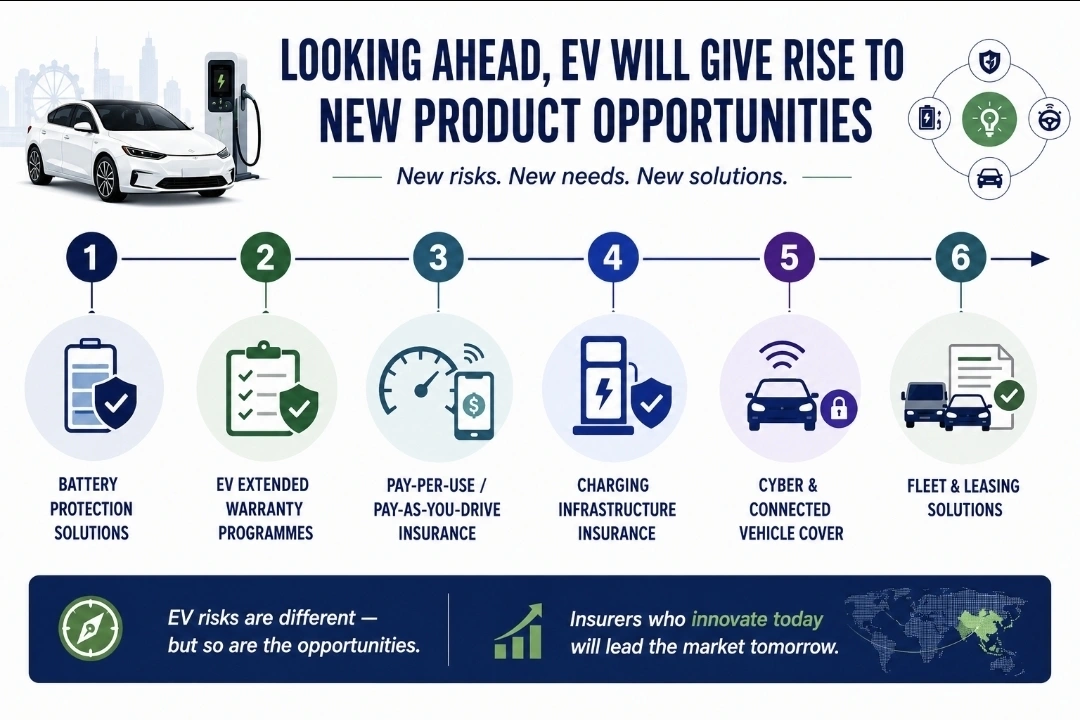
Near-term opportunities include gap insurance as Chinese EV depreciation outpaces internal combustion vehicles, fleet EV cover with telematics-based pricing and depot-charging risks, and charging liability for home and public infrastructure.
Longer term, insurers could explore battery warranty, residual-value protection, OEM exit cover and cyber endorsements for connected vehicles as the regional EV market matures.
The insurers that do well in the EV market will not simply underwrite EVs better. They will build products designed specifically for them.
From case study to product opportunity
Three near-term questions for Southeast Asian insurers.
01
Gap insurance
Depreciation, total-loss thresholds and finance shortfall.
Explore the opportunity02
Fleet EV cover
Telematics, actual use, depot charging and fleet claims.
Explore the opportunity03
Charging liability
Home, workplace, depot and public charging infrastructure.
Explore the opportunityConclusion
The objective is not to have perfect data. It is to use imperfect data better than the competition.
China spent three years and almost US$2.5 billion in cumulative underwriting losses learning how to insure electric vehicles. Its most successful insurers built capability in data, claims management, repair networks and partnerships, and recognised that EVs require different products, not just different pricing.