
EV & NEV insurance · Series 01
China lost US$814m underwriting electric vehicles.
Will Southeast Asia learn from China or repeat its path?
Mandy Phan
Managing Partner · 30 June 2026 · 9-minute read
Central argument
The accounting, the data and the reinsurance structure are one decision, not three.
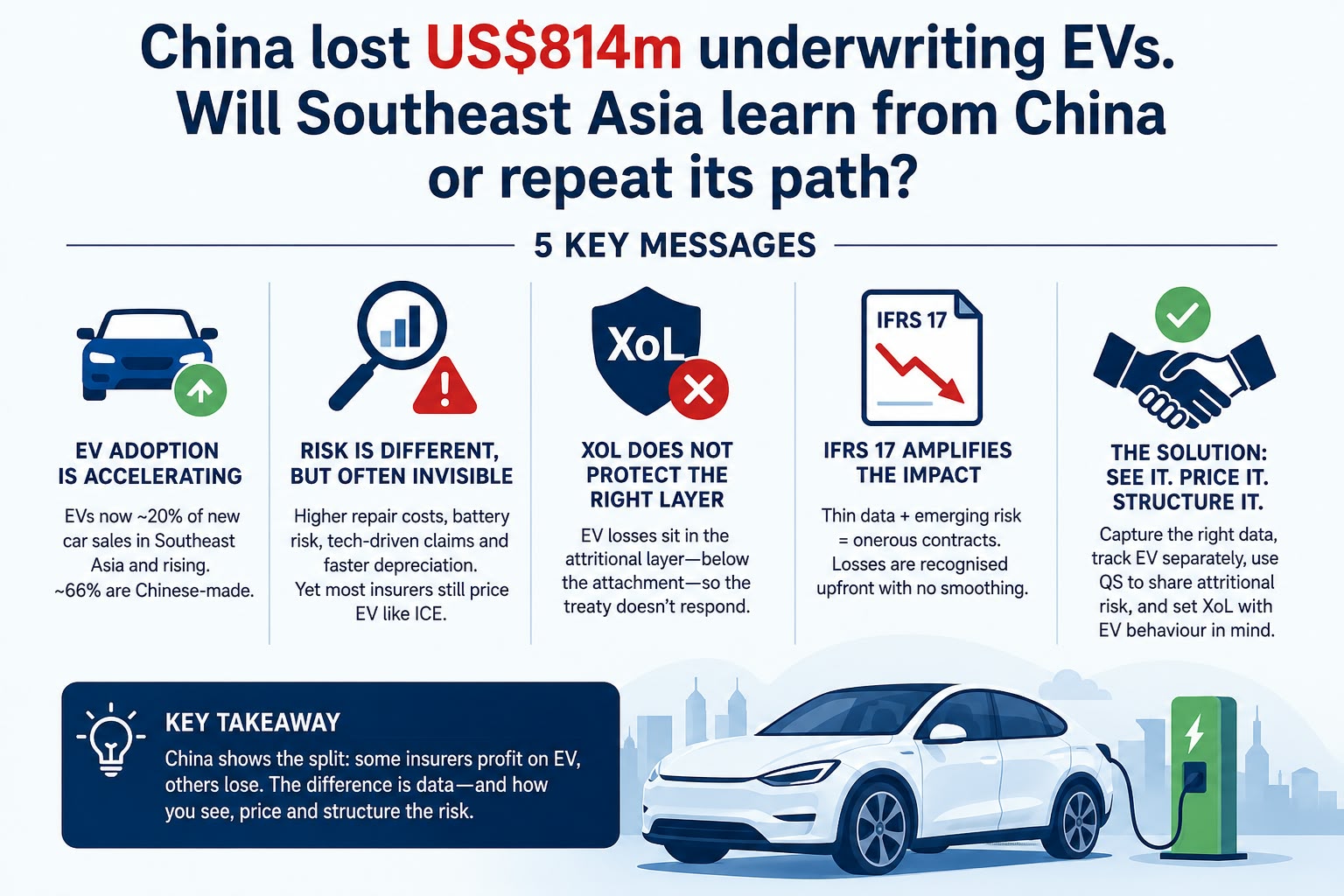
The shift is already here
Electric vehicle adoption across Southeast Asia has moved faster than the data needed to underwrite it. By 2025, EVs accounted for over 40% of new car sales in Singapore, close to 40% in Vietnam and about 21% in Thailand. Government incentives, falling battery costs and expanding infrastructure mean this trend is not reversing.
Around two-thirds of these vehicles are Chinese-made: BYD, MG, GWM and others that barely registered a few years ago now lead sales charts across the region.
How most local insurers are responding
I have been watching this space closely, and the difficulty, I think, is being underestimated. The demand is rising. The question is how to underwrite it. These cars are now on insurers’ books, but most local insurers in Southeast Asia still price, reserve and reinsure them as if they behave like ICE.
From my discussions with major motor players across Southeast Asia, most are studying the trend closely. They tend to fall into two camps. One does not write EV, or writes it selectively. The other writes EV alongside ICE, often with a modest premium loading. But a ~20% loading applied to the same coarse rating factors is not risk-based pricing. It is a guess dressed as an adjustment.
Both feel prudent. Neither quite is.
Why EV risk is different
The reason sits in how the risk actually behaves. EV differs from ICE in ways that cut across both pricing and reserving. Repairs require specialised workshops and high-voltage-certified labour that most markets have in short supply. Sensors and cameras embedded throughout the vehicle mean even minor collisions trigger costly recalibration. Battery packs account for approximately 40% of vehicle value, and fire, while rare, risks a total loss when it occurs.
This is not hypothetical. In Thailand, EV loss ratios have already hit 90–100%, with repair and parts costs running 50–60% higher than ICE. Some insurers have stopped writing EV altogether or moved to case-by-case pricing.
Why current pricing cannot see it
In many Southeast Asian markets, particularly those still operating under tariff or semi-tariff structures, motor pricing turns primarily on sum insured, engine capacity and year of manufacture. Even where markets have liberalised, many local insurers still default to those same variables. Make, model, battery type and driver profile may sit in the system, but if they do not feed into pricing or reserving decisions, the risk stays invisible where it matters.
Then there is depreciation, which I would push hardest on, because it compounds everything above. Depreciation resets what counts as a total loss: a faster-depreciating car crosses the write-off threshold on smaller incidents, so more vehicles are totalled sooner and total-loss frequency climbs with no change in accident rate. Depreciation varies sharply across EV brands, driven by battery longevity, parts availability, manufacturer R&D, price and technology competitiveness, and whether the maker will still be around to support the car in the next ten years. An insurer whose rating does not capture make and model is blind to one of the largest cost drivers in the book.
Why this bites now: IFRS 17
That makes it an estimation problem, not just a pricing one. And under IFRS 17, estimation is where the strain shows.
When the data behind that estimate is thin, the estimate itself is volatile. Under IFRS 4, an insurer could absorb a deterioration gradually, smoothed across reporting periods. Under IFRS 17 that option is gone. Once a group of contracts is expected to run to a net outflow, it is onerous, and the loss is recognised at once.
Emerging risk and thin data together: that is precisely the combination that tips contracts onerous sooner than anyone priced for.
Why the XoL is not enough
Which is why “our motor XoL already covers this” offers less comfort than it appears.
It comes down to structure. Excess of loss responds only above the attachment, the large, infrequent losses. The right instrument for the ICE tail. But the exposures that define EV risk | battery damage, sensor repairs, fire-related write-offs, calibration, total-loss frequency | rarely breach the attachment. They are attritional losses accumulating below the attachment, in the layer that excess of loss never reaches. The treaty does not respond where the losses actually sit, so when IFRS 17 forces recognition, there is no reinsurance offset to cushion the hit.
A quota share addresses exactly this gap. QS does not make the loss disappear | the gross recognition still happens. What it does is allow a loss-recovery component on the reinsurance asset, recognised at the same moment (IFRS 17 paragraphs 66A–66B). Because the reinsurer absorbs its share simultaneously, the amount hitting the insurer’s own P&L is smaller and the reported results are less volatile.
The Blindness Gap
Notice the symmetry. An insurer that prices EV on ICE variables and folds it under the ICE XoL is blind twice over: blind in pricing, because make and model are never captured, and blind in reinsurance, because EV losses sit commingled under a treaty that cannot respond to them. And the answer is the same in both cases: separate EV out, so it can be seen, estimated and structured on its own terms.
In practice, that means capturing brand, make, model, miles and battery type at quote stage in addition to the driver’s profile. Track EV claims experience separately from ICE. Review whether the XoL attachment was set with EV attritional behaviour in mind. Without that, the risk stays invisible.
China shows where this leads
Some Chinese insurers did exactly this and are now profitable on EV, while others continue to bleed. Same vehicles, same market, opposite outcomes. The dividing line was data. Most local insurers in Southeast Asia currently sit on the wrong side of that divide.
Why the profitable ones won | and what the rest of Asia should build from it | is where this series goes next.
But the lesson is already clear. The accounting, the data and the reinsurance structure are one decision, not three. Treat them separately, and the numbers will move before you do.
Next in the series