
IFRS 17 · Reinsurance perspective
IFRS 17 changed reporting. Has reinsurance optimisation changed too?
Mandy Phan
Managing Partner · [DATE TO CONFIRM] · 6-minute read
Central argument
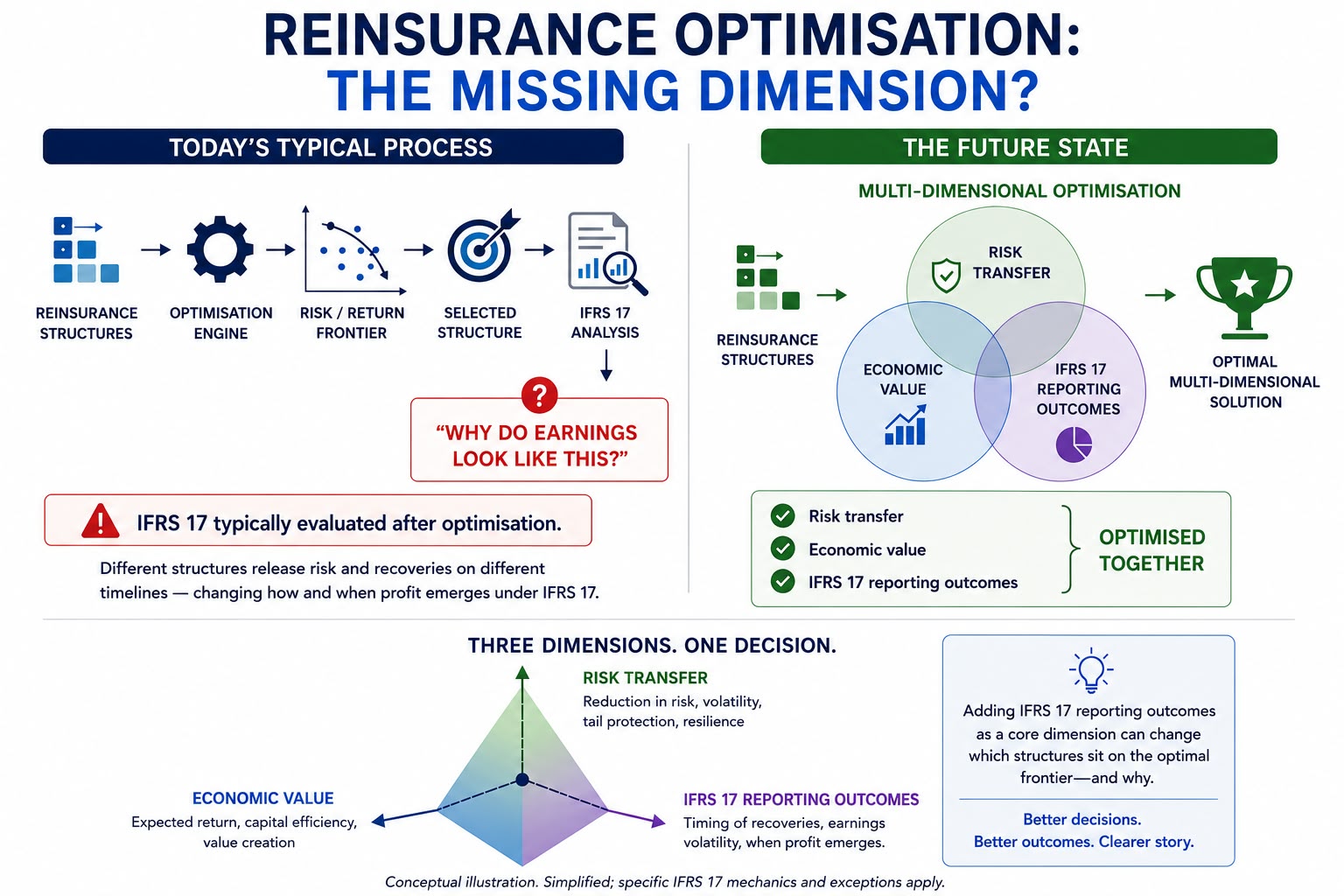
IFRS 17 is no longer just a reporting outcome. It becomes part of the optimisation question itself.
Economically similar reinsurance protection can look different under IFRS 17.
Recoveries, losses and profit may emerge on different timelines | potentially changing how treaty performance is judged.
A reinsurance optimisation is a serious piece of work. Alternative structures are tested through catastrophe, DFA and capital models, then assessed on risk transfer, profitability, earnings volatility, solvency and return on capital before a preferred structure emerges.
Under IFRS 4, the reporting consequences of a reinsurance structure were often easier to anticipate in practice, even if they only became fully visible once results flowed through the accounts.
Under IFRS 17, that link is less intuitive. Reinsurance held is measured separately from the business it protects, and recoveries and profit recognition do not necessarily move in step with the underlying contracts.
That is where the disconnect can arise.
Illustrative comparison
The economics may be similar. The reported story may not be.
A simple example: onerous underlying business, two reinsurance structures with broadly comparable economic protection.
Structure A
Eligible proportionate reinsurance. A loss-recovery component is recognised under the June 2020 amendments, offsetting part of the day-one loss on the underlying business.
Earnings pattern
Recoveries and profit emergence align more closely with the underlying business. Smoother earnings pattern.
Structure B
Comparable economic protection, but the conditions for the loss-recovery treatment are not met. The full loss is recognised upfront; recoveries emerge later.
Earnings pattern
Large upfront loss, recoveries emerging on a different timeline. The reported story diverges from the economics.
Illustrative only. Not actual portfolio data. Based on the loss-recovery component guidance in the June 2020 amendments to IFRS 17.
A reinsurance optimisation is a serious piece of work
A reinsurance optimisation is a serious piece of work. Alternative structures are tested through catastrophe, DFA and capital models, then assessed on risk transfer, profitability, earnings volatility, solvency and return on capital before a preferred structure emerges.
Under IFRS 4, the reporting consequences of a reinsurance structure were often easier to anticipate in practice, even if they only became fully visible once results flowed through the accounts.
Under IFRS 17, that link is less intuitive. Reinsurance held is measured separately from the business it protects, and recoveries and profit recognition do not necessarily move in step with the underlying contracts.
That is where the disconnect can arise.
Economically similar protection, a different reported story
A simple example is onerous underlying business.
In Structure A, eligible proportionate reinsurance may allow a loss-recovery component to be recognised under the June 2020 amendments to IFRS 17, offsetting part of the loss on the underlying business at inception.
In Structure B, an arrangement with broadly comparable economic protection may not meet the conditions for that treatment, so the full loss is recognised upfront and recoveries emerge later.
The economics may be similar. The reported story may not be.
Why this matters beyond the cedant
That matters not only for how cedants interpret treaty performance, but for how boards, investors, regulators and rating agencies may read the financial result. A treaty can deliver meaningful protection economically and still look underwhelming in a given period, simply because recoveries and profit emergence do not line up with the underlying business in the way decision-makers expect.
At that point, IFRS 17 is no longer just a reporting outcome. It becomes part of the optimisation question itself.
A more integrated framework
Reinsurance optimisation may now need a more integrated framework | one that weighs economic alongside reporting implications, and stress-tests both while alternatives are still being compared.
A structure can always be revisited at the next renewal. But by the time the reporting consequences surface in the financial statements, they have already shaped how that year's performance is read | and that view cannot be taken back.
Conclusion
By the time the reporting consequences surface in the financial statements, they have already shaped how that year's performance is read | and that view cannot be taken back.